


“The team is knowledgeable about content and design.” — Senior Manager, Marketing, Kotak Securities.
In September 2025, we started publishing twice a week for a professional working in the IPO and capital markets space.
The focus was straightforward: share useful information for people working in or following the industry. We built the content around educational topics, practical guidance and industry news, with explanations that helped readers understand why a development mattered.
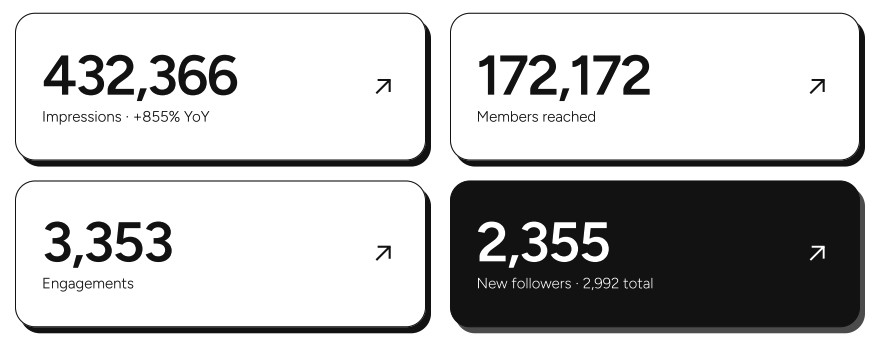
Over the following year, the account’s content generated 432,366 impressions, reached 172,172 members, and recorded 2,355 new followers.
We kept the content closely connected to the client’s field and the questions his audience would find relevant.
The strategy covered three main areas:
We also made sure that each post offered some value.
A company filing, for example, was rarely interesting just because a company had filed for an IPO. We looked for the details inside it: an unusual transaction, an acquisition, a related-party disclosure, a regulatory issue or something that could help readers understand the IPO process better.
That gave us two useful types of content.
Timely company and industry posts helped us reach new people when there was already interest around a topic. Educational posts gave us a way to keep building around the client’s expertise even when there was no major news to react to.
We maintained the same frequency throughout: two posts every week.
Between 29 September 2025 and 28 September 2026, the account recorded:
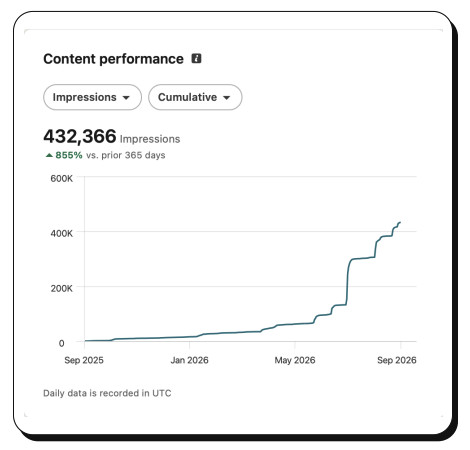
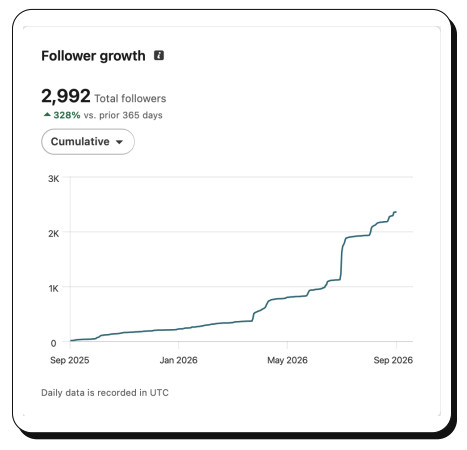
LinkedIn also recorded an 855% increase in impressions compared with the previous 365-day period.
The biggest gains came from posts tied to current IPOs and company filings.
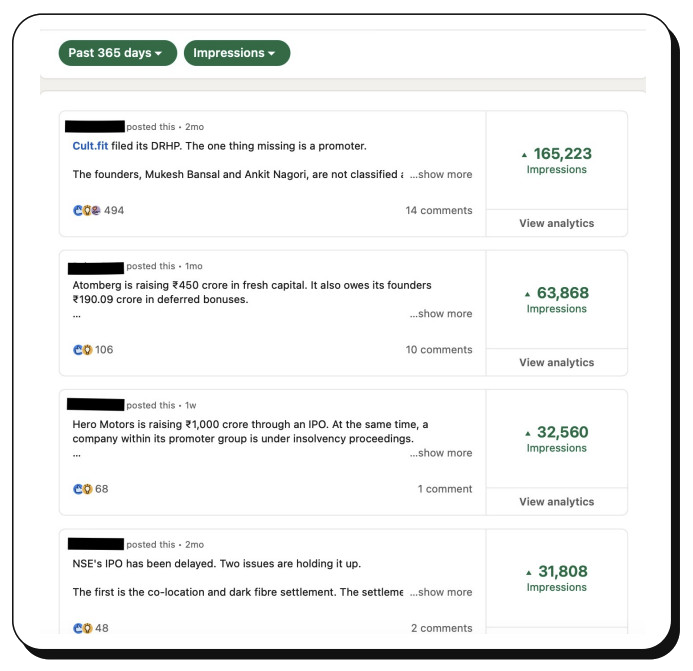
The Cult.fit post reached 165,223 impressions. Posts on Atomberg, Hero Motors and the NSE IPO were also among the strongest performers. Together, the top four posts contributed around 68% of annual impressions.
Educational posts also performed well. A post on IPO due-diligence blind spots received 5,548 impressions and 68 engagements, while a post on what happens after filing a DRHP received 8,904 impressions and 100 engagements.
This gave us a useful mix: timely posts helped expand reach, while educational content kept the account useful between major industry developments.
The results varied across the year, with the strongest period coming later.
July through 28 September contributed 78% of annual impressions and 60% of recorded new followers.
That timing matters when looking at the overall outcome. We had been publishing consistently for several months before the biggest posts took off. Earlier educational posts were already attracting attention, and the later breakout posts substantially expanded the account’s visibility.
The data supports a story of sustained publishing followed by a strong period of growth. It also shows how much a few successful posts contributed to the final numbers.
The audience was closely aligned with the industry we were writing for.
We also reached founders and senior professionals. 7% of followers had Founder as their job title, 2% were Co-Founders and 3% were Owners, alongside Directors, Partners, VPs and CXOs.
Followers also came from companies such as EY, Deloitte, PwC, NSE India, BSE India, ICICI Bank and HDFC Bank.
So we weren’t just growing the follower count. We were building visibility with people who were actually relevant to the client’s work.
For us, this case shows the value of staying consistent with a clear subject focus.
We kept publishing information relevant to the client’s field, explaining technical topics and adding context to industry developments. Over the year, that work accompanied substantial growth in reach and followers, with several posts reaching much wider audiences.
The practical lesson is to keep giving the right audience something useful to read, and give the approach time to develop.
Impressions
Impressions vs prior year
New followers