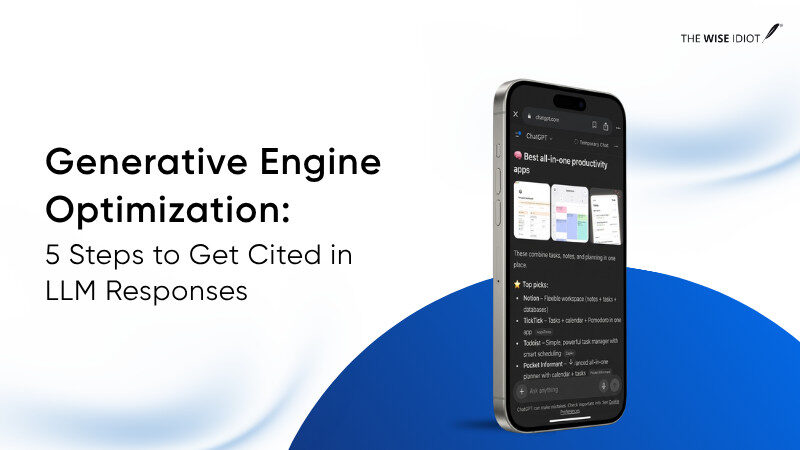
TLDRGenerative Engine Optimization (GEO) is the practice of structuring content so AI systems cite it in their responses. Here, the goal has shifted from ranking on SERPs to being used in answers. Here are 5 steps to get cited:
|
Anyone who has used Google long enough knows how search used to work. You typed a query, compared a few links, and made a decision.
That model has changed dramatically in just the last two to three years.
Today, a growing number of users skip the comparison step entirely. They ask ChatGPT or Perplexity a question and get a single, synthesised answer. Which creates a new reality for content teams.
If your content is not being used to generate that answer, it does not matter where it ranks. It is effectively invisible.
This is the shift from search visibility to answer inclusion. And it is exactly what generative engine optimization is designed to solve.
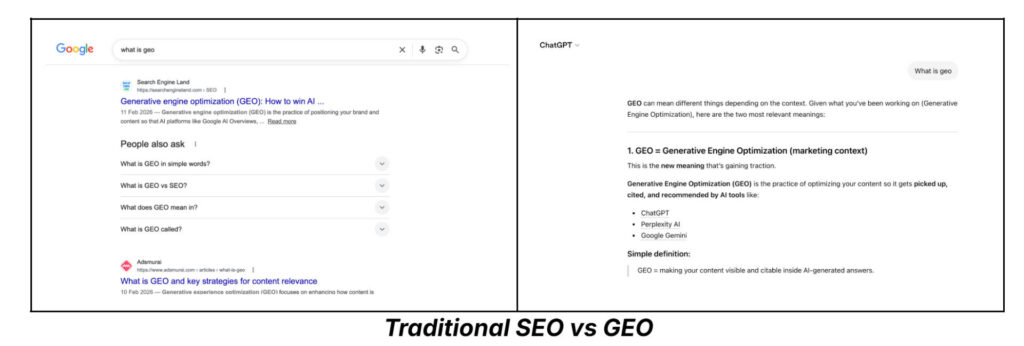
What is Generative Engine Optimization?
Generative Engine Optimization is the process of optimizing content so it gets cited by AI-powered systems like ChatGPT, Perplexity AI, and Google’s AI-powered search experiences.
How does GEO work?
Unlike traditional search engines that list links, AI systems generate answers. And this shift is driven by large language models, or LLMs.
LLMs build their responses in two primary ways:
- using knowledge learned during training
- retrieving real-time information from the web through a method known as Retrieval-Augmented Generation (RAG)
In RAG-powered systems like Perplexity and ChatGPT Search, the model fetches live web pages and builds an answer from them. If your content is not structured in a way that can be easily picked up and used, it gets skipped.
The scale of this shift is hard to ignore. AI tools like ChatGPT and Perplexity now handle 56% of global search-related sessions, according to data tracked by Search Engine Land.
The old goal was: Rank #1. The new goal is: get cited.
🧠 Is GEO replacing SEO?
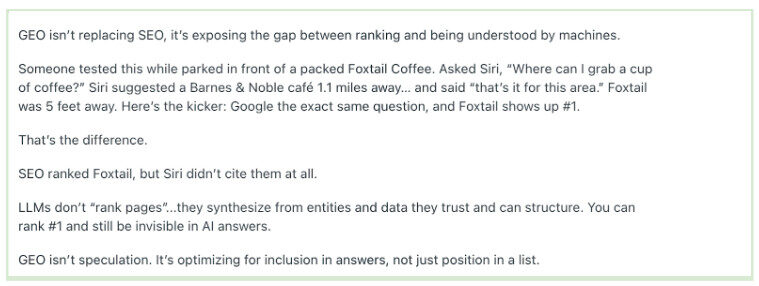
Not really. As a reddit user puts it, it is shifting the focus from ranking for visibility to writing clear, useful content that AI models can easily cite and summarize.
Why Should You Optimize for Generative Engines?
With search shifting toward AI-generated answers, being cited has become key to visibility and trust. Let’s break down why.
-
The zero-click shift is accelerating
Zero-click searches have been increasing over the past few years. In 2025, around 58.5% of searches in the U.S. and 59.7% in the EU ended without a click, according to Semrush.
AI tools take this further. When users receive a complete answer inside platforms like ChatGPT or Perplexity, they often do not need to visit another site. In such scenarios, being cited becomes an important way to remain visible.
-
AI traffic is high-intent
Users who come through AI platforms behave differently from traditional search visitors. Their queries are longer, more specific, and closer to real-world problems. Instead of short keywords, users describe context, constraints, and intent in full sentences.
As a result, they arrive with a clearer understanding of what they need, making them more likely to engage meaningfully with the content or product.
-
LLMs amplify brand authority at scale
When a brand is cited within an AI-generated response, it carries a different kind of weight. Instead of appearing as one of many links, it becomes part of a consolidated answer.
This can influence how users perceive the brand, even if they do not immediately click through. Over time, repeated inclusion in responses helps build credibility and trust.
-
Early movers have an advantage
At the moment, relatively few teams are actively optimizing content for AI citations. This creates an opportunity for brands that start investing early.
As models begin to rely on certain sources for specific topics, those sources may continue to appear across similar queries. Building visibility early can make it more difficult for competitors to replace that position later.
5 Steps to Get Cited in LLM Responses
Step 1: Structure your content for AI comprehension
LLMs do not read your content the way humans do. They scan it, break it into smaller parts, and decide if a section is clear enough to use.
They struggle with large blocks of text and work better with well-structured content. Poor structure makes the content harder to cite.
Here is how to structure for AI comprehension:
- Use clear H2/H3 headings so LLMs can understand sections as standalone answers.
- Write in short paragraphs with clear subheadings.
- Add structured data. Use FAQ schema, HowTo schema, Article schema, and BreadcrumbList to help AI systems understand your content better.
- Keep metadata accurate. Title, description, author name, and publish date all signal trust to both AI systems and readers.
- Keep content fresh. Content updated in the past three months is twice as likely to be cited as older pages. Set a regular update schedule for important pages.
📝 Pro tip: Do not focus on word count.
Although many content teams still focus on hitting a certain word count, research from Ryan Law shows that content length has almost no connection to AI citations. In fact, 53% of citations go to pages under 1,000 words. Clear, structured, and direct content performs better than long content.
Step 2: Put the answer first
Generative engines look for the most direct answer to a question. The most important step for getting cited is placing a short, clear answer of 40–60 words right at the top of your content, just below the H1 or H2. This targets the “Direct Answer” section that AI systems prefer.
In fact, 44% of LLM citations come from the first 30% of content.
Here are some practical rules you can keep in mind:
- Start each section with a 1–2 sentence direct answer before adding more detail
- Use question-style H2s and H3s to match how users ask questions
- Add a short “definition paragraph” at the top of each key section
- Do not hide the answer. If it is not in the first two sentences, rewrite the section
Author’s note: A good example of this is the TL;DR section at the top of this post. And the “what is geo?” section that directly dives into the definition before tying it back to how LLMs work.
Step 3: Add trust signals throughout
LLMs try to avoid showing incorrect information. They prefer content that looks reliable, factual, and trustworthy. You can ensure that by adding:
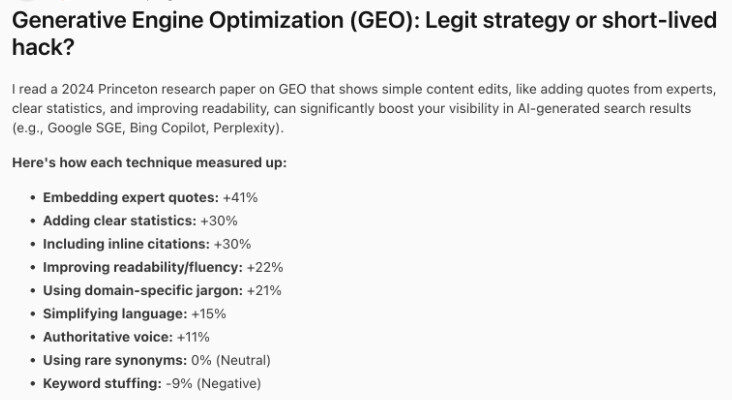
- Statistics: Add clear, sourced data points. For example, you can add “embedding expert quotes improves visibility by 41%” rather than saying “expert quotes improves your chances of showing up in GEO.”
- Expert quotes: Include quotes from known experts. Content with 2–3 strong quotes sees a 41% increase in citation rates.
- Clear language: Use direct statements like “X is Y that does Z.” Avoid unsure phrases like “we believe” or “it seems.”
- Author details: Include author role, experience, and publish date. This builds trust for both AI systems and readers.
Step 4: Target long-tail conversational queries
People search differently in AI tools. ChatGPT prompts are much longer, around 5.5 words on average, 60% longer than Google.
Users include full context and ask detailed questions like: “what is the best generative engine optimization strategy for a B2B SaaS company with a limited content budget?”
Short keywords do not match how AI systems find answers.
To optimise:
- Build content around question clusters like “how,” “why,” “what is the difference,” and “which is better”
- Use FAQ sections. These match both Google’s People Also Ask and AI queries
- Make each section a complete answer. LLMs often pull only one section from a page
- Focus on specific, niche queries. These are easier to rank for and get cited
Step 5: Build off-page authority where LLMs learn
Your content will not get cited if your brand is not trusted.
LLMs are trained on the open web. Being mentioned on trusted third-party platforms increases your chances of being cited more than self-promotion.
One of the most important findings comes from Ryan Law, Content Marketing Director at Ahrefs. After analyzing over 1 billion data points, his team found that YouTube mentions are the strongest predictor of AI visibility. This is higher than backlinks or domain authority. Both Google and OpenAI use YouTube content, and it appears frequently in AI answers.
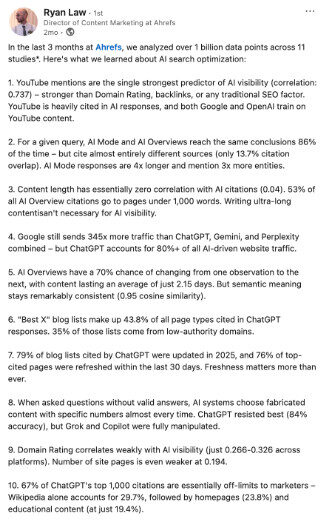
Snapshot of Ryan Law’s LinkedIn post
His research also showed that domain authority has only a weak link to AI visibility. This gives smaller brands a real opportunity.
Priority platforms you should focus on:
- YouTube: The most important channel. Create videos based on the same topics as your written content
- Reddit: Frequently cited in AI responses. Share useful, non-promotional answers
- LinkedIn: Publish expert content on your main topics
- Review platforms: G2, Capterra, and others help build credibility
- Digital PR: Get mentioned in industry publications and research articles
- Wikipedia and Wikidata: Having accurate entries improves how your brand is recognized
Here’s how The Wise Idiot put their GEO strategy in action
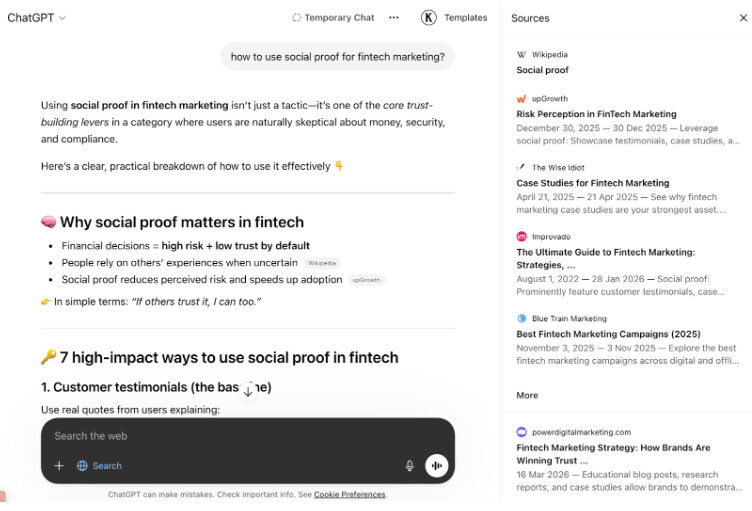
What we suggested above is the exact strategy we use for our blogs at The Wise Idiot, and we have seen the impact.
Take this piece, for example: A Currency in Fintech Marketing. We kept it simple. Clear structure, real examples, and straight answers. And LLMs picked it up, showing it only next to Wikipedia (one of the most cited websites in LLMs).
How to Measure Your GEO Performance
GEO measurement is still maturing, but the core metrics are clear. Set a baseline today so you have something to compare against as your strategy develops.
| Metric | What to Track |
| Citation frequency | How often your brand or URL appears in LLM answers |
| Share of voice | Your mentions vs. competitors across AI responses |
| Prompt coverage | How many relevant queries trigger your content |
| Traffic from AI referrers | Direct visits from Perplexity, ChatGPT, and AI Overviews |
Tools to use:
- Profound for enterprise-level citation tracking and competitor share of voice
- Evertune for brand mention monitoring across LLMs
- Manual prompt testing across ChatGPT, Perplexity, and Claude using your target queries
- GA4 with UTM tagging to capture referral traffic from AI platforms
Bonus: How do you apply GEO to your content?
Want a structured LLM citation optimization framework for your content immediately? We put together a step-by-step LLM SEO framework based on what we have seen work across client campaigns.
Download the LLM SEO Framework
FAQs on Generative Engine Optimization
Q1: Is generative engine optimization the same as SEO?
No, GEO and SEO are not the same. Traditional SEO focuses on ranking in search results, while GEO focuses on getting cited in AI-generated answers. Both are complementary, and strong SEO still helps AI systems find and trust your content.
Q2: Which LLMs should I optimize for?
You should start with ChatGPT, Perplexity, and Google’s AI-powered search results. Each platform relies on different sources, so optimizing across multiple platforms improves your chances of being cited.
Q3: Does GEO work for small websites?
Yes, it does. Even smaller websites can get cited if their content is clear, well-structured, and focused on a specific topic. Depth and clarity often matter more than size or authority.
Q4: How long does it take to see GEO results?
Initial changes can show results within a few weeks, especially if you improve structure and clarity. However, building consistent visibility and authority typically takes a few months.
Q5: Will GEO replace SEO?
No, GEO will not replace SEO. Traditional SEO still plays an important role, while GEO adds a new layer focused on being cited in AI responses rather than just ranking in search results.