TL;DR Summary
SEO in 2026 is no longer just “Google SEO.” Consumers now discover brands through AI assistants, social platforms, marketplaces, visual search, and interactive content. The new rules focus on multi-channel visibility, brand authority, machine-readable structure, and trust.
It’s not about ranking on search engines anymore; it’s about being discoverable everywhere people look. SEO is no longer a checklist; it’s an ecosystem.
Introduction
If you’ve been in digital marketing long enough, you’ve watched SEO reinvent itself more times than social platforms redesign their home screens. But 2026 feels different.
This time, search isn’t just changing, it’s spreading across entirely new discovery paths.
People now move between platforms the way we scroll through OTT apps looking for “something better.” With 5.2 billion social media users worldwide, discovery has turned into a cross-platform journey.
One moment they’re watching an Instagram Reel, the next they’re checking reviews on Amazon, comparing opinions on Reddit, or asking an AI assistant for alternatives. Somewhere in that maze, your brand needs to show up, clearly, consistently, and with personality.
How SEO Got Here?
Back in the early days, SEO was simple, where it required you to write some keywords, get some backlinks, pray to the Google gods and rank.
Brands treated search like a filing system. If you said the right words in the right order, Google magically placed you on Page 1. Content farms flourished, keyword stuffing was a sport, and ranking felt mechanical.
But then consumers got smarter. And Google got much smarter. Updates like Panda, Penguin, and BERT reshaped SEO completely.
- Panda: Cracked down on thin, low value content.
- Penguin: Went after manipulative link building tricks
- BERT & Others: Focused on understanding search intent
Several similar updates were used in order to make brands understand that it wasn’t just about tricking algorithms, it was actually about serving people.
And now, with multimodal search, AI generated answers, and conversational browsing becoming the norm, the rules have shifted once again. And SEO has moved far beyond keywords, and brands need to keep up.
How Consumer Behavior Has Evolved
A decade ago, consumers searched with one intent and one platform in mind, “Google it.” Today, discovery looks nothing like that.
Consumers now research micro moments. They spot a product in a friend’s photo, and in a very long process they start with:
- Comparing prices on a marketplace,
- Reading long form opinions on Reddit, and
- Ask an AI assistant to confirm their choice.
This shift is behavioral. People trust social proof more than brand claims. They rely on creators more than ads, because for them it is more informational than that of the latter. Search is no longer an action, it’s rather a continuous conversation happening across platforms.
And the bottom line is that consumers don’t wait for brands to guide them. They guide themselves. If you’re not present in the places they naturally explore, they won’t find you, even if you’re ranking at the top somewhere else.
These behavioral shifts set the foundation for the new rules brands must adapt to in 2026.
New SEO Rules for 2026
Rule 1: Search Everywhere Optimization
Brands must optimize for google, social platforms, marketplaces, AI assistants, apps, and digitally connected environments, because discovery now happens everywhere, not just search engines.
People no longer search in one place, they search wherever they spend time at. That means brands must optimize for Google, Instagram, YouTube, Amazon, Pinterest, and AI chatbots.
So, it is important for brands to evolve in accordance to what the consumers are consuming at the current time period, be it Reddit recommendations, or the ones given by the influencers.
Rule 2: Varied content formats
You’ve probably experienced this yourself, you hear a song somewhere, it gets stuck in your head, but the lyrics just won’t come to you. It’s annoying, right? So you open YouTube, tap the mic, hum a few seconds, and suddenly the song pops up.
That’s the new reality of search.
Consumers now look for information using text, voice, images, humming, screenshots, and even short videos, and they do it more frequently than ever.
Which means your content can’t just be readable. It needs to be recognizable, adaptable, and visually searchable across multiple formats. Brands should create: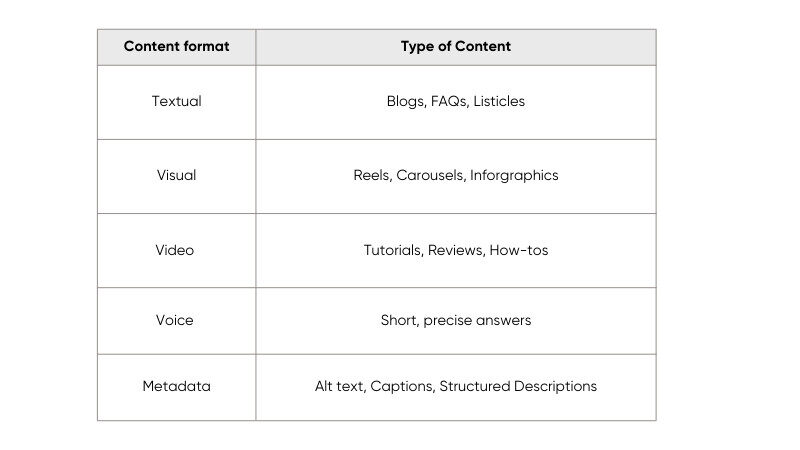
For example, a travel brand covers “Best Places in Bali” through a blog, Instagram reel, YouTube video, and Pinterest board. Same topic, but different formats. It shows how with the increase in formats it also leads to increase in reach for your brand.
But formats alone aren’t enough. In 2026, the real judge of your content is AI.
Rule 3: AI-Readable Content
In 2026, AI is the new search engine. Tools like ChatGPT, Gemini, and Perplexity don’t “browse” your site, they rather interpret it. This means your content must be factual, structured, and machine readable. Think of it like writing notes for a very smart but very literal student.
To make your brand rank in the first few. It is important to create AI-readable content:
- Factual, structured information
- Clear headings and consistent topics
- Accurate data and schema markup
In addition to this, it is vital to understand that it should be interesting to common people, because nowadays, AI is the one which first selects the right content and provides it to the customer which is further read by them.
Rule 4: Brand authority matters more than keyword strategy
The days of stuffing keywords into every corner of your website are long gone. In 2026, search engines and AI assistants care far more about who you are than what exact phrase you used. Authority has officially overtaken keyword strategy, and honestly, it’s about time.
Platforms now want to recommend brands that won’t embarrass them. Even if two brands sell the exact same product, the one that feels more real, transparent, and endorsed will almost always win. The most important things that matter during this time period is:
- High quality reviews, which are detailed, genuine, provide proof that humans really love your product.
- Expert opinions, like chefs reviewing food related products, are much more reliable and convincing than that of a layman.
- Reputation across platforms, what’s being said about you everywhere else, Instagram comments, Amazon reviews, LinkedIn posts, and even news articles.
Rule 5: The role of E-E-A-T
E-E-A-T might look like a simple acronym at first glance, but you see this plays a quite important part in your brand visibility. Experience, Expertise, Authoritativeness, Trustworthiness is E-E-A-T, which is no longer something only SEO nerds talk about. It’s become the backbone of how search engines and AI decide who deserves visibility.
And here’s the twist, E-E-A-T is not just what you write, it’s who you are, it creates your identity. Search engines now reward brands where:
- Real experts overpower generic content
- Real experiences build credibility
- Transparency matters
If your content comes from someone who has actually done the thing, tested the thing, or lived the thing, you automatically gain credibility.
A dermatologist breaking down a skincare routine will always rank higher than a random beauty blog rephrasing the same tips. Not because of keyword density. Not because of length. But because real expertise beats generic content every single time.
How Brands Can Implement These Changes?
Becoming discoverable in 2026 means doing the right things and doing them in the places your audience already hangs out. Here’s how brands can adapt without losing their sanity:
-
Map discovery points
Understand where your audience actually searches. For some brands, it’s Instagram and YouTube. For others, it’s Amazon, Pinterest, or Reddit. Visibility only matters where your customers are.
-
Maintain a consistent brand voice
Whether it’s a Google snippet or a Reel, your brand should “sound” unmistakably like you. And as a known fact consistency builds trust, and disjointed messaging breaks it.
-
Optimize for humans and AI
Writing in clear, structured pages, alt text, metadata, visuals, FAQs, all of these make your content easy for machines to interpret and easy for people to enjoy.
-
Choose platforms wisely using the RICE Framework:
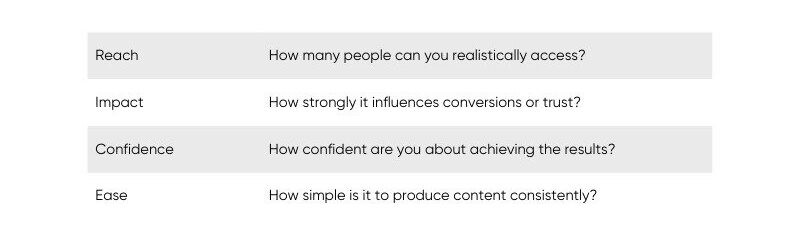
Not all platforms deserve your time, score each platform once at a time. This keeps your strategy intentional instead of chaotic.
Conclusion
SEO didn’t die, it simply grew up.
Search in 2026 is all about understanding people, meeting them where they choose to discover, and showing up as a brand that genuinely knows what it’s talking about. Consumers today move fast, compare constantly, and trust selectively.
If there’s one thing the past decade of SEO has taught us, is the fact that visibility isn’t earned by stuffing keywords, it’s earned by earning trust.
The brands that embrace multi platform discovery, invest in authority, pair expertise with personality, and optimize for both humans and AI will be the ones leading the next search revolution.
About The Wise Idiot
We’re The Wise Idiot, and yes, that’s really our name. We’re a content marketing agency that’s been helping startups and growing brands tell their stories since 2017.
Here’s what we do: we take the stuff that makes your business special and turn it into content that actually works. Whether that’s writing that doesn’t put people to sleep, websites that make visitors stick around, or social media that gets people talking, we handle it all.
FAQs
1. Is traditional SEO still relevant in 2026?
Yes, Google search still matters. But it’s no longer enough on its own. Brands also need visibility across social platforms, AI assistants, marketplaces, and apps.
2. Do brands need to be on every platform?
No. Choose platforms based on where your audience actually searches. Use the RICE Framework, which is Reach, Impact, Confidence, and Ease, to prioritize wisely.
3. What is Search Everywhere Optimization?
It’s the practice of optimizing brand discoverability across multiple channels, not just Google, but also including Instagram, YouTube, TikTok, Amazon, Reddit, and AI tools.
4. Why is brand authority more important than keywords now?
People trust experts, reviews, real experiences, and recommendations. Search engines and AI tools also favor credible, proven brands over keyword-heavy content.
5. How can brands make content AI readable?
Use clear structure, concise language, accurate facts, schema markup, proper metadata, and organized site architecture so AI models can easily understand and recommend your content.