
On this page
OpenAI launched Business Hub in beta on November 10, 2026, giving businesses a way to claim their presence on ChatGPT, manage business information and track how users discover and engage with them.
The platform offers insights into brand mentions, profile views, website clicks and discovery topics. However, it doesn't reveal individual user prompts, conversations or competitor performance.
For brands, this is an important step towards measuring AI visibility using first-party data. But tracking mentions is only one part of the equation. Building credible content, maintaining consistent brand information and earning citations across trusted sources remain essential to improving AI search visibility.
A customer asks ChatGPT to recommend the best investment platforms in India. It names three brands, compares their features and links to their websites. Your brand isn't among them.
You know your website ranks well on Google. Your content team publishes regularly. Your SEO reports show steady organic traffic. But you have no way of knowing how often ChatGPT recommends your competitors or why your brand is missing from those conversations.
Until recently, this was one of the biggest measurement gaps in AI search.
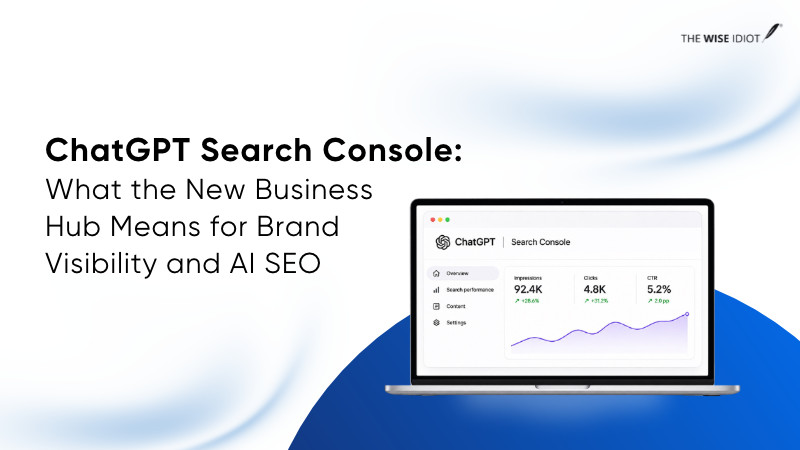
On November 10, 2026, OpenAI introduced Business Hub, a new platform that gives businesses access to insights about how they appear and perform on ChatGPT. Often described as ChatGPT Search Console, it brings something brands have been waiting for: first-party visibility data directly from the platform.
But what does it actually measure? How is it different from Google Search Console? And, more importantly, how should marketing teams use it? Let's break it down.
What is ChatGPT Search Console?
ChatGPT Search Console is the informal name used to describe OpenAI's new Business Hub, introduced as part of its broader Businesses in ChatGPT initiative.
It is a platform where businesses can claim and verify their presence on ChatGPT, manage their business information, and access insights into how users discover and interact with them.
According to OpenAI's November 10 announcement, ChatGPT reaches 1.2 billion people every week. As more users turn to it to research products, compare services and make decisions, being discoverable on the platform is becoming an important part of brand visibility.
Business Hub aims to give businesses more control over this presence. Once verified, businesses can:
- Update their business information.
- Add product feeds with pricing and availability.
- Track brand mentions and website clicks.
- Monitor profile views.
- Explore discovery topics that show common themes in conversations where their websites are cited.
In simple terms, it brings together two things: business profile management and AI visibility measurement.
How does ChatGPT Business Hub work?
Business Hub is currently available in beta. Businesses can access it through ChatGPT and claim their organisation after completing the verification process.
Here's how its key features work.
1. Claim and verify your business
Businesses can search for their organisation through Business Hub and initiate an ownership claim.
OpenAI requires businesses to verify their identity before they can manage their profiles. Shopify merchants can connect their stores through Business Hub or Shopify to simplify the process.
Once verification is approved, businesses can manage the information associated with their presence on ChatGPT.
This is particularly useful for brands with multiple products or services, where outdated information can lead to inaccurate AI-generated recommendations.
2. Track brand mentions and website clicks
One of the most important features is access to engagement data. Businesses can see how often ChatGPT mentions them and how many users click through to their websites.
This creates two useful measurement points:
- Visibility: How frequently your business appears in ChatGPT's discovery ecosystem.
- Engagement: How often users move from ChatGPT to your website.
For marketing teams, this provides a better understanding of whether their brand is being discovered through AI-powered search and whether that visibility is translating into website visits.
3. Understand discovery topics
Business Hub also introduces discovery topics. These are common themes across conversations where ChatGPT cites a business's website.
For example, an insurance company might discover that its website is being cited in conversations around:
- Term insurance for young professionals.
- Health insurance for families.
- Comparing health insurance policies.
- Understanding insurance exclusions.
This can help marketing teams identify the broad subjects associated with their brand and find opportunities to strengthen their content around relevant customer questions.
However, discovery topics are not a substitute for individual search queries. Businesses don't get access to the exact questions users ask or their private conversations.
4. Manage product information
Businesses can also add product feeds containing information such as pricing and availability.
This is particularly relevant for ecommerce brands, where outdated product details can affect the quality of recommendations users receive.
Keeping product information current gives ChatGPT access to more accurate details when helping users compare available options.
5. Explore Business Agents
OpenAI has introduced another feature alongside Business Hub: Business Agents. These are AI-powered assistants that businesses can build using their own information and product feeds.
When users discover a business on ChatGPT, they can visit its profile and interact with its Business Agent to ask follow-up questions about products or services.
For example, someone comparing two insurance plans could explore their features, exclusions and suitability through a business's agent.
However, there's an important distinction. Business Agents are currently available only to eligible ecommerce and online service businesses in the United States. They are not yet available to all businesses globally.
ChatGPT Search Console vs Google Search Console: What's the difference?
Both platforms help businesses understand how users discover their websites. But they operate in different search environments and provide different types of insights.
| Parameter | Google Search Console | ChatGPT Business Hub |
|---|---|---|
| Primary purpose | Measure website performance on Google Search | Measure business discovery and engagement on ChatGPT |
| Visibility metrics | Search impressions | Business mentions |
| Traffic metrics | Search clicks | Website clicks |
| Query insights | Search queries | Discovery topics |
| Competitor data | No direct competitor benchmarking | No competitor benchmarking |
| Business information | Not a business profile management tool | Manage business details and product feeds |
| Search environment | Google Search | ChatGPT |
The biggest difference is the level of insight available.
Google Search Console provides query-level data, allowing marketers to understand which searches generate impressions and clicks.
Business Hub currently provides aggregated insights. It doesn't reveal the exact prompts users enter, individual conversations or how competitors are performing.
This means marketers can understand whether their visibility is increasing or decreasing, but may not always know exactly which questions are driving those changes.
For now, the two tools should complement each other rather than replace one another.
What does ChatGPT Search Console mean for SEO and AEO?
The introduction of Business Hub marks an important shift in how brands can measure their presence in AI-powered search.
Until now, marketers largely depended on third-party AI visibility tools that tested selected prompts across platforms to estimate how frequently brands appeared in AI-generated answers.
Business Hub adds something different: first-party data from ChatGPT itself. But better measurement doesn't automatically translate into better visibility. There are three important implications for brands.
1. AI visibility becomes measurable
One of the biggest challenges with AEO has been measuring performance. Traditional SEO offers familiar metrics such as impressions, clicks, rankings and organic traffic. AI search, on the other hand, has made it harder to understand whether a brand is being mentioned, cited or recommended.
Business Hub gives marketers a new set of metrics to work with. They can track changes in mentions, website clicks and discovery topics over time, helping them understand whether their AI visibility efforts are gaining traction.
This also makes it easier to bring AI visibility into regular marketing reports instead of treating it as an experimental metric.
2. Content strategy needs to go beyond keyword rankings
A brand might rank on the first page of Google and still be absent from ChatGPT responses.
That's because AI engines don't simply reproduce traditional search rankings. They retrieve information from different sources, evaluate its relevance and assemble answers based on the user's context.
A Semrush analysis found that Reddit and LinkedIn were among the most frequently cited domains across AI search platforms. This reinforces an important point: your website is not the only source shaping how AI systems understand your brand.
Brands need to invest in:
- Clear, well-structured content that directly answers customer questions.
- Original insights, research and subject matter expertise.
- Consistent brand information across websites and third-party platforms.
- Credible mentions in industry publications and relevant communities.
- Authoritative content that demonstrates experience and trust.
For a deeper look at this approach, read our complete guide to Answer Engine Optimisation (AEO) for brand managers.
3. Visibility needs to translate into business outcomes
Getting mentioned by ChatGPT is useful, but it isn't the end goal. A brand might receive hundreds of mentions without generating meaningful website traffic or enquiries. Another brand might receive fewer mentions but attract users with stronger purchase intent.
This is why marketers need to look beyond visibility metrics. Track AI mentions and website clicks alongside:
- Referral traffic from ChatGPT
- Engagement on landing pages
- Qualified enquiries and leads
- Branded search growth
- Assisted conversions
The objective is to understand whether AI visibility is attracting the right audience and contributing to business growth.
What we've seen work: Preparing your brand for ChatGPT Search Console
Business Hub gives marketers a new measurement tool. But the work required to improve AI visibility remains largely the same.
Based on the principles of SEO and AEO, here's where brands should start.
1. Audit how ChatGPT currently describes your brand
Before making changes, understand your starting point. Ask ChatGPT relevant questions about your industry, products and services. Check whether your brand appears, what information it shares and which competitors it recommends.
Look for inconsistencies, outdated details and gaps in how your offerings are represented.
2. Strengthen your website content
Your website should make it easy for AI systems and users to understand what your business offers.
Focus on:
- Clear service and product descriptions.
- Dedicated pages for important offerings.
- Question-led content that addresses customer concerns.
- Updated statistics, references and examples.
- Author information and credible sources.
Avoid publishing content simply to target more keywords. Focus on answering questions that matter to your audience.
3. Build authority beyond your website
AI visibility is influenced by how consistently and credibly your brand appears across the web.
Invest in thought leadership, industry publications, expert contributions, LinkedIn content and relevant third-party mentions.
The goal is to build a consistent and credible digital footprint that reinforces what your brand stands for.
4. Claim your business on Business Hub
If your business is eligible, visit ChatGPT Business Hub and initiate the verification process.
Once approved, review your business details, update product information and establish a baseline for your mentions and website clicks. This will help you compare future performance against your starting point.
5. Monitor performance across AI platforms
Business Hub covers ChatGPT, not the entire AI search ecosystem. Continue monitoring your presence across Google AI Overviews, AI Mode, Gemini and Perplexity.
Use a combination of first-party analytics, Google Search Console, website analytics and AI visibility tracking tools to build a more complete picture.
ChatGPT Search Console Readiness Checklist
Before making AI visibility a regular part of your marketing strategy, use this checklist to assess your brand's readiness.
- Business information is accurate and consistent across platforms.
- Website content clearly explains products and services.
- Important customer questions have dedicated, useful answers.
- Content includes credible sources, relevant expertise and updated information.
- Brand mentions and thought leadership extend beyond the website.
- Business Hub ownership has been claimed and verified, where eligible.
- Baseline mentions, clicks and discovery topics have been recorded.
- AI referral traffic and business outcomes are being monitored.
The future of AI search is about being discoverable and trusted
The launch of ChatGPT Business Hub is a significant step towards making AI search performance more measurable.
For the first time, businesses have access to platform-level insights that help them understand how they are being discovered and how users engage with them on ChatGPT.
But the tool doesn't change the fundamentals of AI visibility. A brand cannot simply claim its profile, update its details and expect ChatGPT to recommend it more often. Visibility still depends on having useful content, credible information and a consistent presence across trusted sources.
The real opportunity lies in combining measurement with meaningful optimisation. Brands that understand what their audience is asking, create content that answers those questions and build authority beyond their websites will be better positioned as AI-powered discovery continues to evolve.
Frequently Asked Questions
What is ChatGPT Search Console?
ChatGPT Search Console is an informal term for OpenAI's Business Hub. Launched on November 10, 2026, it allows businesses to manage their presence on ChatGPT and track mentions, profile views, website clicks and discovery topics.
Is ChatGPT Business Hub free?
Yes. Business Hub is currently available in beta without a fee. OpenAI has not announced a paid pricing model for the platform.
How can I add my business to ChatGPT Business Hub?
Visit chatgpt.com/business-hub, search for your business and initiate the ownership verification process. Once approved, you can manage your business information and access available insights.
Can I see which prompts users enter in ChatGPT?
No. Business Hub provides aggregated insights and discovery topics, not individual prompts, user identities or private conversations.
Does ChatGPT Business Hub replace Google Search Console?
No. Google Search Console measures how websites perform on Google Search, while Business Hub provides insights into how businesses are discovered and engaged with on ChatGPT. Both tools serve different purposes and should be used together.
Let's build your AEO strategy
At The Wise Idiot, we believe the future of search belongs to brands that are not just visible, but worth trusting. As ChatGPT changes how people discover and evaluate brands, showing up in the right conversations matters more than ever. Let's build a content and AEO strategy that makes your brand easier to find, understand and trust.
 Since 2017
Published · Last updated
