A founder’s view on how the LinkedIn algorithm actually distributes content in regulated categories – and the 60/30/10 model we use at The Wise Idiot to balance organic and paid for fintech brands.
By Divyank Jain, Partner, The Wise Idiot · Reading time: 6 minutes
I run a content and marketing agency. Over the last few years, we’ve worked with 400+ clients across 8 countries – and a meaningful chunk of that work has been LinkedIn marketing for BFSI and fintech brands. Last quarter, one of our fintech clients – a fixed-income platform in its fixed deposit phase – closed Q1 2026 with 1.38 million LinkedIn impressions and a 3.32% engagement rate, well above the BFSI category benchmark.
Here’s the part most marketers don’t want to hear: 94% of those impressions came from paid promotion. Only 6% were organic.
That single number explains why most fintech brands keep underperforming on LinkedIn – and why the answer isn’t “post more” or “boost more”. It’s both, in a very specific ratio, with a very specific kind of content. This blog walks through what we saw, what we did, and the operating model we now use across every fintech account at The Wise Idiot.
The State of LinkedIn for Fintech Brands in 2026
LinkedIn organic reach for regulated categories – banking, financial services, insurance, lending – has been in structural decline for two years. The platform’s algorithm increasingly throttles brand pages in compliance-heavy verticals. A SaaS or D2C brand can still get away with a punchy organic-only strategy. A fintech brand, especially one in the fixed deposit or fixed income space, cannot.
At the same time, LinkedIn is a platform where the ideal audience for fixed income is active. We’re talking about CXOs, founders, finance professionals, and HNIs evaluating where to park ₹2–50 lakhs. They’re on LinkedIn during their lunch break, between meetings, actively engaging with content on personal finance, investing, the Indian economy and more.
So the brand awareness question for fintech is no longer “should we be on LinkedIn?” It’s “how do we win there when organic distribution is broken?”
The answer we’ve arrived at after running this for several fintech clients: stop treating organic and paid as two separate strategies.
What 66 Posts in 90 Days Actually Looked Like
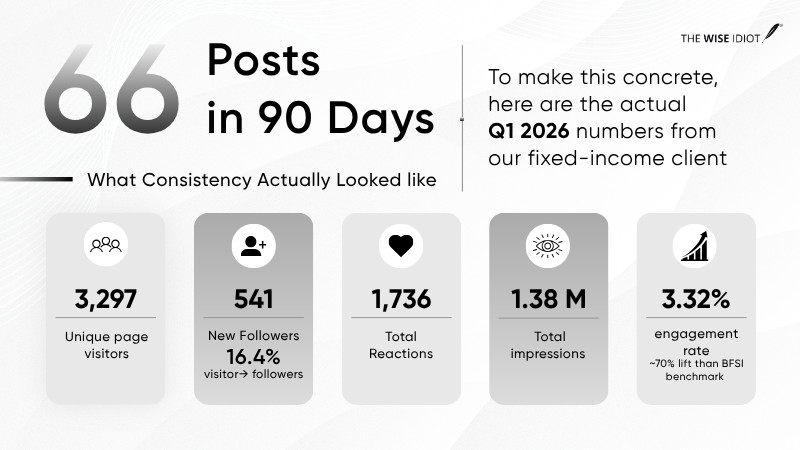
To make this concrete, here are the actual Q1 2026 numbers from our fixed-income client (not naming the brand for confidentiality, but the category and stage are accurate):
- 66 posts published in 90 days (roughly 5 a week)
- 3,297 unique page visitors
- 541 new followers – a 16.4% visitor-to-follower conversion
- 1,736 total reactions across 66 posts
- 1,381,820 total impressions (1.38M)
- 3.32% average engagement rate – a ~70% lift on the BFSI benchmark of 1.8–2.2%
The engagement rate matters more than any other number on this list. 3.32% means the content is working – when LinkedIn shows it to someone, they’re reacting, commenting, or clicking. That’s the creative bar cleared.
But the impressions split – 1.3M paid versus 81,000 organic – is the honest story. Even great content needs help getting in front of the right people in this category.
Why Organic Alone Fails for Fintech Brands
I’ll keep this short because most marketers already feel this in their bones.
A brand page in fintech can publish a beautiful, sharp, well-designed carousel and get 30 likes. The same exact post, when boosted to a defined ICP audience – say, founders and finance leaders in tier-1 Indian cities with a ₹5L+ salary band – can pull 50,000+ impressions and become the top driver of profile visits that month.
The platform isn’t going to give you free reach in a category where it knows it can charge you. That’s not a conspiracy – it’s the business model. LinkedIn earns more per impression from BFSI advertisers than almost any other vertical, which means BFSI brand pages have to fight harder for organic distribution than almost anyone else.
Why Paid Alone Fails Too
This is the part agencies don’t talk about enough, because it costs them billable hours.
If you only run paid promotion on average creative – generic market-update carousels, reposted Bloomberg headlines, “rate cut imminent” speculation posts – you’ll get impressions, but no engagement. No saves. No follower growth. No DMs. You’ll burn your media budget showing the world that your brand has nothing to say.
We saw this clearly in the bottom quartile of engagement on LinkedIn for our fintech client this quarter. The posts that underperformed all shared a pattern: generic VC commentary (“the trillion dollar market”), market speculation (“Will markets fall more?”), and off-category content (a “Top 5 car companies” post that confused both the audience and the algorithm).
These posts received the same paid push as the winners. They returned almost nothing.
Paid amplifies what’s there. If the creative is weak, paid amplifies weakness.
The Content Types That Actually Worked
The posts in the top quartile of engagement told a different story. Three patterns emerged.
1. Topical, news-jacked content tied to category moments
Posts on the Union Budget, Republic Day, Women’s Day, Strait of Hormuz and even the India World Cup victory pulled outsized engagement. Cultural moments give a fintech brand permission to show up as a brand, not just a product.
2. A repeatable explainer franchise
A series called “Fixedin60” – 60-second product explainers on things like “secured vs unsecured bonds” and “how coupon rates work” gained traction and engagement. This single franchise accounts for two of the top five posts of the quarter. Recurring formats compound recall. They give the audience something to expect, and they give the LinkedIn algorithm a clear signal to lean into.
3. Relatable content
A carousel called “Investments as Foods” appeared in both the top-engaged and most-liked lists. Fintech is a category drowning in jargon. Whoever translates it into something a human can feel, wins.
By format, carousels and infographics outperformed every other type. By day, Thursdays, Mondays, and Tuesdays returned the highest engagement – which is now the publishing window where we anchor every fintech brand we run to.
How Our Team Operationalises the 60/30/10 Balance
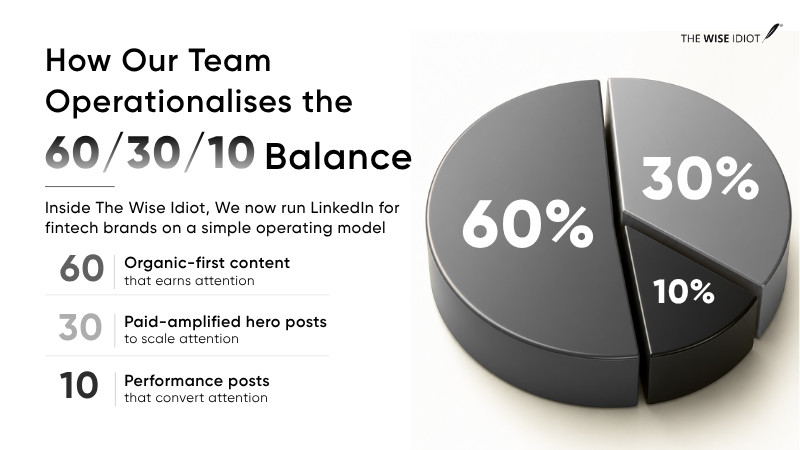
Inside The Wise Idiot, we now run LinkedIn for fintech brands on a simple operating model:
- 60% organic-first content that earns attention – the franchises, the relatable content, the cultural moments, built to earn engagement on their own merit
- 30% paid-amplified hero posts to scale attention – organic winners boosted to ICP audiences for compounded reach
- 10% performance posts that convert attention – hard CTA posts based on high-performing ads on Meta.
We never put paid behind a post that hasn’t crossed an organic engagement threshold first. If it doesn’t work organically, boosting it just makes the failure more expensive.
We also ruthlessly cut posts that don’t fit the brand’s lane. The “Top 5 car companies” post is a small example with a big lesson: every off-category post you publish trains LinkedIn’s algorithm to deprioritise your future content. The clearer your content lane, the more compounding your distribution.
What This Means for Your Fintech Brand
If you’re a fintech brand trying to build awareness on LinkedIn – especially in fixed income, lending, or wealth – three questions matter more than the rest.
- Is your creative good enough to earn engagement before paid amplification?
- Is your media budget being spent on your top-performing organic posts, or on whatever the latest brief asked for?
- Are you publishing in repeatable, recognisable franchises, or starting from zero every week?
Get those right, and you’ll see what we saw last quarter – a 3.32% engagement rate in a category where the benchmark is half that, and a 16.4% visitor-to-follower conversion that compounds month after month.
Get them wrong, and no media budget will save you.
Work With The Wise Idiot
We’ve helped fintechs across India and the US figure out the organic-paid balance, build content franchises that compound, and run LinkedIn as a real awareness engine instead of a posting habit. If you’d like to talk through how this applies to your brand, reach out to us – or read more on our content marketing approach and BFSI case studies.
– Divyank Jain, Partner, The Wise Idiot